Contents
Prep time45 minutes Chilling Time 1 hour Bake Time 50–55 minutes
Total time~2 hours 40 minutes
Servings4 large pasties Initial Heat Intensity High: 200°C (400°F) / Fan 180°C / Gas 6 Finishing Heat Intensity Moderate: 170°C (340°F) / Fan 150°C / Gas 3
Equipment
- Large mixing bowl
- Rolling pin
- 20 cm (8-inch) plate or side bowl (to use as a circular cutting template)
- Sharp chef’s knife & cutting board
- Large heavy-duty baking sheet lined with parchment paper
- Pastry brush
- Measuring spoons and kitchen scale
Ingredients
Traditional Shortcrust Pastry
- 500 g (4 cups) Strong white bread flour or unbleached all-purpose flour
- 120 g (½ cup + 1 tbsp) Cold unsalted butter, cubed
- 120 g (½ cup + 1 tbsp) Cold lard or vegetable shortening, diced
- 1 tsp Fine sea salt
- 175–180 ml (¾ cup) Ice-cold water
The Authentic Filling
- 350 g (12 oz) Beef skirt or chuck steak, trimmed and finely diced into 5 mm cubes
- 200 g (7 oz) Swede (rutabaga), peeled and finely diced
- 250 g (9 oz) Waxy potatoes (e.g., Maris Piper or Yukon Gold), peeled and finely diced
- 150 g (5 oz) Yellow onion, finely diced
- 1 tsp Coarse sea salt
- 1½ tsp Freshly cracked black pepper (traditional pasties lean peppery)
- 25 g (2 tbsp) Cold butter, divided into 4 small pats
Glaze
- 1 large egg , lightly beaten with 1 tbsp milk
Advertisement
Instructions
Step 1: Make the Sturdy Pastry
- Combine the flour and salt in a large chilled mixing bowl.
- Add the cold cubed butter and lard. Rub the fats into the flour using your fingertips until the mixture resembles coarse breadcrumbs with small pea-sized pieces remaining.
- Gradually pour in the ice-cold water, stirring with a round-bladed knife until the dough starts coming together.
- Turn the dough onto a lightly floured surface. Knead firmly for roughly 1–2 minutes until the dough becomes smooth, pliable, and elastic. (Note: Unlike dessert pastry, pasty dough requires enough gluten development to hold its shape and prevent tearing during crimping).
- Shape the dough into a smooth disc, wrap tightly in cling film, and chill in the refrigerator for at least 1 hour .
Step 2: Prepare the Raw Filling
- Cut the beef skirt, peeled swede, potatoes, and onion into uniform 5 mm dice. Keep each ingredient separate until assembly to ensure balanced distribution.
- In a small ramekin, blend the 1 tsp sea salt and 1½ tsp cracked black pepper.
- Do not pre-cook any filling ingredients. Authentic pasties rely on raw braising inside the pastry steam chamber.
Step 3: Roll and Fill
- Preheat the oven to 200°C (400°F) / Fan 180°C / Gas Mark 6. Line a large heavy baking tray with baking parchment.
- Remove the chilled pastry from the fridge and divide it into 4 equal portions (approx. 185 g each).
- Roll each portion on a lightly floured worktop into a round disc roughly 3–4 mm thick. Place a 20 cm (8-inch) plate on top and trim away excess edges to yield a neat circle.
- Layer the filling across the center line of each pastry circle: Bottom layer: Diced swede and potato
- Middle layer: Diced yellow onion
- Top layer: Diced beef skirt
- Season each portion evenly with the salt and pepper mixture. Top the beef on each pasty with a small dot of cold butter.
Step 4: Fold, Seal, and Crimp
- Lightly brush the perimeter edge of the pastry circle with water or beaten egg glaze.
- Bring the two opposite pastry sides up over the filling to meet at the top, pressing the edges firmly together to seal the ingredients inside an airtight envelope.
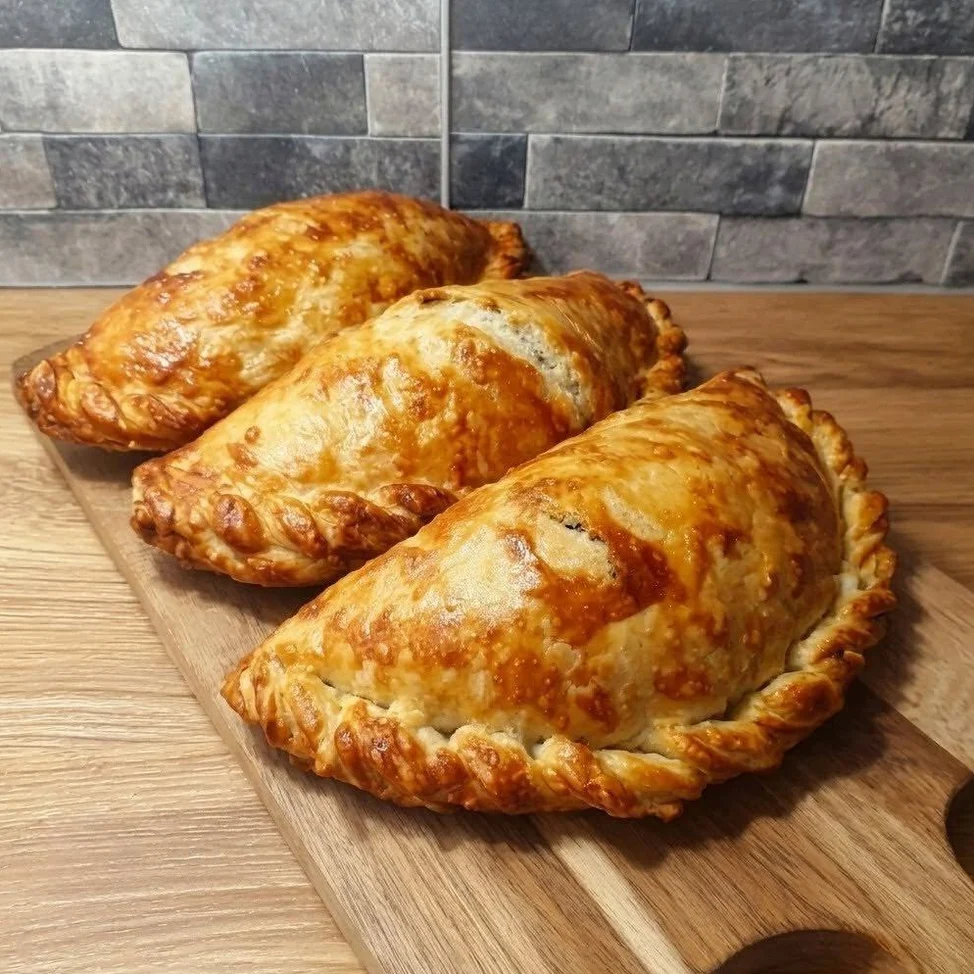
- Crimp the Edge: Using your thumb and index finger, twist and fold small sections of the sealed seam over itself in overlapping diagonal tucks (from one side to the other) to create the signature rope-style crust along the side or top ridge.
- Transfer each sealed pasty to the prepared baking tray, leaving at least 5 cm of space between them.
Step 5: Glaze and Two-Stage Bake
- Brush the entire exterior of each pasty thoroughly with the egg wash for a deep golden sheen.
- Use the tip of a sharp knife to prick two small steam release holes in the top of each pasty.
- Stage 1 (Initial High Heat): Bake at 200°C (400°F) for 20 minutes until the crust sets and begins turning light golden.
- Stage 2 (Braising Heat): Lower the oven temperature to 170°C (340°F) / Fan 150°C / Gas 3 without opening the oven door for long. Continue baking for 30–35 minutes until the crust is rich golden-brown and the internal vegetables are fully tender.
- Remove from the oven and allow pasties to cool on the baking tray for 15–20 minutes before serving. This resting window allows the hot juices and steam to settle back into the filling.
Advertisement
Nutrition
Calories: 720 kcal · Protein: 28 g · Fat: 42 g · Carbohydrates: 58 g Dietary · Saturated Fat: 20 g · Fiber: 4 g · Sugar: 3 g · Sodium: 820 mg
Advertisement