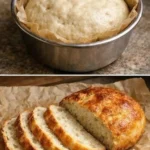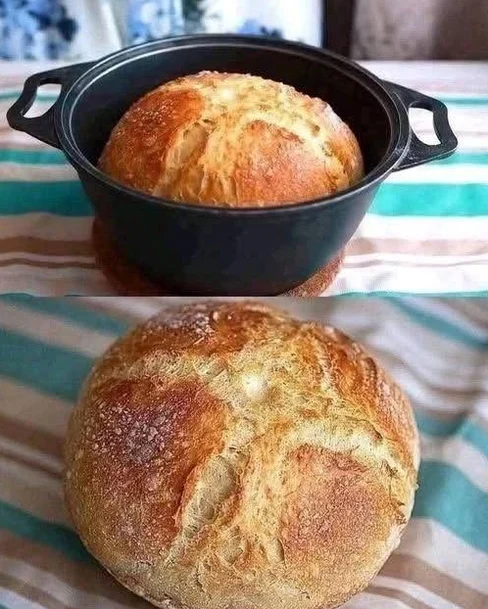
A high-hydration, no-knead artisan bread recipe designed for a cast-iron Dutch oven, featuring a long overnight fermentation for complex flavor and an open, airy crumb.
Equipment
- Digital kitchen scale
- Large glass or ceramic mixing bowl
- Sturdy wooden spoon, silicone spatula, or Danish dough whisk
- Plastic wrap or snug silicon lid
- Parchment paper
- 4.5 to 6-quart cast-iron Dutch oven with lid
- Sharp razor blade or kitchen shears
- Heavy-duty oven mitts
- Wire cooling rack
Ingredients
- 450 g (approx. 3 ½ cups) Unbleached All-Purpose or Bread Flour
- 360 g (1 ½ cups) Lukewarm Water (70°F–78°F / 21°C–25°C)
- 10 g (2 teaspoons) Fine Sea Salt or Kosher Salt
- 2 g (½ teaspoon) Instant or Active Dry Yeast
Instructions
- Whisk together 450g flour, 10g fine sea salt, and 2g instant yeast in a large bowl until evenly distributed.
- Pour in 360g lukewarm water and stir with a sturdy wooden spoon, silicone spatula, or Danish dough whisk until all dry flour is fully hydrated. The dough will look shaggy, sticky, and wet. Do not knead.
- Cover the bowl tightly with plastic wrap or a snug silicon lid. Place in a draft-free spot at room temperature (68°F–72°F / 20°C–22°C) and let ferment undisturbed for 12 to 18 hours until more than doubled in size, bubbly, and slightly tangy.
- Lightly dust a sheet of parchment paper with flour or cornmeal. Gently scrape the wet dough onto a floured work surface. Do not punch down.
- Fold the edges inward toward the center to form a round shape. Flip the dough seam-side down onto the prepared parchment paper.
- Lightly dust the top with flour, cover loosely with a clean kitchen towel, and let proof for 30 to 45 minutes.
- While the dough proofs, place a 4.5 to 6-quart cast-iron Dutch oven (with lid on) on the middle rack of the oven. Preheat to 450°F (230°C) for 30 minutes.
- Carefully remove the hot Dutch oven using heavy-duty oven mitts and set on a heat-safe surface. Remove the lid.
- Score a 1/2-inch deep slash across the top of the proofed dough using a sharp razor blade or kitchen shears.
- Using the parchment paper as a sling, lift the dough and lower it into the preheated pot. Place the lid back on and return to the oven. Bake for 30 minutes.
- Remove the lid. Continue baking uncovered for 12 to 15 minutes until the crust reaches a deep mahogany finish.
- Lift the bread out using the parchment sling and transfer to a wire cooling rack. Allow to cool completely for at least 1 hour before slicing.
Notes
Resist slicing hot bread to avoid a gummy interior. Use parchment paper to prevent scorching the bottom crust and ease transfer. Wet or flour hands when handling sticky dough. Store cooled loaf cut-side down on a wooden board or in a brown paper bag for 48 hours to maintain crispiness. Freeze sliced bread with parchment dividers for up to 3 months.
Nutrition
Calories: 145 kcal · Total Fat: 0.5 g · Saturated Fat: 0.1 g · Trans Fat: 0 g · Cholesterol: 0 mg · Sodium: 325 mg · Total Carbohydrate: 29 g · Dietary Fiber: 1.2 g · Total Sugars: 0.3 g · Protein: 4.8 g · Calcium: 8 mg · Iron: 1.8 mg · Potassium: 50 mg