Contents
EquipmentIngredientsFor the Yeast Starter:For the Dough:For the Egg Wash & Topping:InstructionsStep 1: Activate the YeastStep 2: Mix the Wet Ingredients & Flour BaseStep 3: Knead the DoughStep 4: First ProofingStep 5: Shape the Round Challah (4-Strand Basket Weave Technique)Step 6: Second Proofing & First Egg WashStep 7: Bake to PerfectionStep 8: CoolingNutrition
Prep time30 minutes Rest/Proof Time 2 hours 30 minutes (2 distinct proofs) Bake Time 35–40 minutes
Total time3 hours 40 minutes
Servings1 large round loaf (12 slices)
Equipment
- Large mixing bowl or stand mixer fitted with a dough hook
- Measuring cups and spoons (or digital kitchen scale for precision)
- Plastic wrap or a clean kitchen towel
- Baking sheet lined with parchment paper
- Pastry brush
- Wire cooling rack
Ingredients
For the Yeast Starter:
- Active Dry Yeast: 2¼ teaspoons (1 standard packet / 7g)
- Warm Water: 1 cup (240ml), heated to 105°F–110°F (40°C–43°C)
- Honey: 1 teaspoon (to feed the yeast)
For the Dough:
- All-Purpose Flour or Bread Flour: 4 to 4½ cups (500g–560g), unbleached
- Honey: ⅓ cup (115g), or granulated sugar
- Neutral Vegetable Oil: ⅓ cup (80ml), such as canola, sunflower, or avocado oil
- Large Eggs: 2 whole eggs + 1 egg yolk (at room temperature)
- Fine Sea Salt: 1½ teaspoons (9g)
For the Egg Wash & Topping:
- Large Egg: 1 whole egg
- Cold Water: 1 tablespoon
- Pinch of Salt
- Optional Toppings: 1–2 tablespoons sesame seeds, poppy seeds, or coarse sanding sugar
Advertisement
Instructions
Step 1: Activate the Yeast
- In a large bowl or the bowl of a stand mixer, combine 1 cup of warm water ( $105^\circ\text{F} – 110^\circ\text{F}$ ), 2¼ teaspoons of active dry yeast , and 1 teaspoon of honey .
- Whisk gently to combine and allow the mixture to sit undisturbed for 5 to 10 minutes .
- The surface should become frothy, bubbly, and fragrant. If no foam develops, your yeast may be inactive or the water temperature was too hot; discard and start fresh.
Step 2: Mix the Wet Ingredients & Flour Base
- To the activated yeast mixture, add the remaining ⅓ cup honey , ⅓ cup vegetable oil , 2 whole eggs , and 1 egg yolk . Whisk until completely smooth.
- Add 3½ cups of the flour along with 1½ teaspoons of sea salt .
- Using a wooden spoon or the paddle attachment on your stand mixer, mix at low speed until a shaggy dough begins to form.
Step 3: Knead the Dough
- By Stand Mixer: Switch to the dough hook attachment. Knead on medium-low speed for 6 to 8 minutes , gradually adding the remaining ½ cup of flour a tablespoon at a time until the dough pulls away cleanly from the sides of the bowl.
- By Hand: Turn the shaggy dough out onto a lightly floured surface. Knead continuously for 8 to 10 minutes , pressing forward with the heel of your hand, folding over, and turning. Add minimal extra flour only as needed to prevent sticking.
- Testing Doneness: The finished dough should feel smooth, elastic, and slightly tacky, but not sticky. It should pass the “windowpane test” (stretching a small piece thinly without tearing).
Step 4: First Proofing
- Lightly grease a large bowl with half a teaspoon of oil.
- Form the dough into a smooth ball and place it in the bowl, turning once so the surface is lightly coated.
- Cover the bowl tightly with plastic wrap or a damp kitchen towel.
- Place in a warm, draft-free spot for 1.5 to 2 hours , or until the dough has doubled in volume.
Step 5: Shape the Round Challah (4-Strand Basket Weave Technique)
- Gently punch down the risen dough to release excess gas. Turn it out onto a clean work surface (no extra flour needed).
- Divide the dough into 4 equal pieces using a bench scraper or sharp knife (approx. 220g per piece).
- Roll each piece into a long strand roughly 14 to 16 inches in length , keeping the thickness uniform along the length.
- Weaving the Crown: Lay 2 strands vertically parallel to each other, about an inch apart.
- Lay 2 strands horizontally over and under the vertical strands to create a basic woven cross pattern at the center (resembling a tic-tac-toe grid).
- Take the 4 strands pointing under and weave them over the adjacent strands going clockwise.
- Take the strands pointing under and weave them counter-clockwise over the adjacent strands.
- Repeat until you reach the ends of the strands.
- Tuck all four loose ends under the center knot to form a neat, round, dome-shaped loaf.
- Transfer the shaped round loaf onto a large parchment-lined baking sheet.
Step 6: Second Proofing & First Egg Wash
- Whisk 1 egg , 1 tablespoon cold water , and a pinch of salt in a small bowl until completely uniform.
- Brush a thin, even coat of egg wash over the entire surface of the loaf, ensuring you cover the woven folds. Reserve the remaining egg wash for later.
- Allow the loaf to rise uncovered in a warm spot for 45 to 60 minutes , until visibly puffy and pillow-like.
Step 7: Bake to Perfection
- Preheat your oven to 350°F (175°C) with an oven rack positioned in the middle.
- Gently apply a second coat of egg wash over the risen loaf. This second application gives challah its signature deep mahogany shine.
- Sprinkle generously with sesame seeds or poppy seeds across the top, if desired.
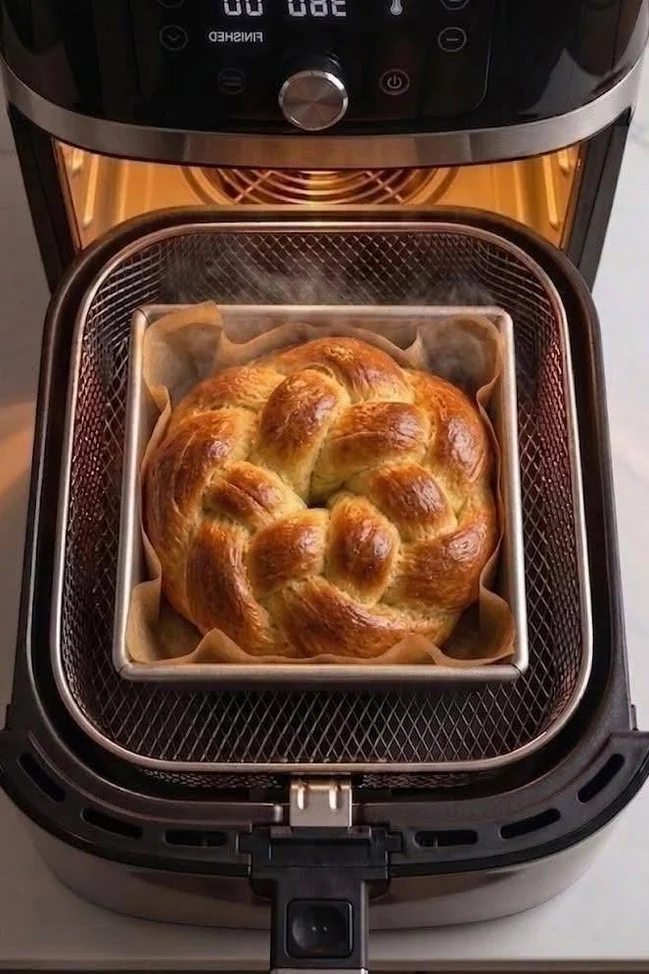
- Bake at 350°F (175°C) for 35 to 40 minutes .
- Check at the 20-minute mark; if the top is browning too rapidly, tent the loaf loosely with aluminum foil for the remainder of the bake time.
- The challah is fully baked when the deep golden color reaches inside the braided crevices and an instant-read thermometer inserted into the center reads 190°F to 200°F (88°C–93°C) .
Step 8: Cooling
- Remove from the oven and allow the bread to rest on the baking sheet for 10 minutes.
- Transfer the loaf to a wire rack to cool completely before slicing. Slicing while warm can compress the interior crumb.
Advertisement
Nutrition
Calories: 230 kcal — · Protein: 6g 12% · Fat: 7.5g 10% · Carbohydrates: 35g 13% Dietary · Saturated Fat: 1.2g 6% · Fiber: 1.5g 5% · Sugar: 7g — Includes Added · Sodium: 310mg 13%
Advertisement