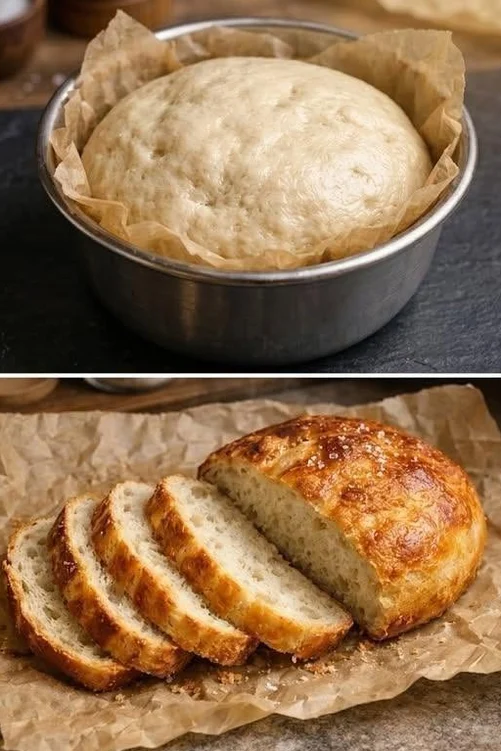
A beginner-friendly, low-effort recipe for a round boule that relies on a long, passive fermentation to develop gluten and flavor, resulting in a crispy crust and soft crumb.
Prep time10 minutes
Cook time45 minutes
Total time~13 to 20 hours (mostly passive)
Servings1 Round Boule (approx. 8–10 slices)
Equipment
- Heavy 5- to 7-quart Dutch Oven
- Mixing Bowl
- Spatula
- Parchment Paper
- Plastic Wrap or Beeswax Wrap
- Wire Cooling Rack
Ingredients
- 3 1/2 cups (450g) All-Purpose Flour or Bread Flour
- 1/4 teaspoon (1g) Instant Yeast or Active Dry Yeast
- 1 1/2 teaspoons (9g) Fine Sea Salt or Kosher Salt
- 1 5/8 cups (390ml) Lukewarm Water (approx. 70°F–80°F / 21°C–27°C)
Advertisement
Instructions
- In a large glass or ceramic mixing bowl, whisk together the flour, salt, and dry yeast until evenly distributed. Pour in the lukewarm water. Using a wooden spoon or sturdy spatula, stir until a wet, sticky, shaggy dough forms with no dry flour pockets remaining. Do not knead or overmix.
- Cover the bowl tightly with plastic wrap or an airtight lid. Place the bowl in a draft-free room kept around 68°F–72°F (20°C–22°C). Allow the dough to rest undisturbed for 12 to 18 hours until it doubles in size, bubbles across the surface, and carries a pleasant fermented aroma.
- Lightly dust a work surface and your hands with flour. Scrape the wet dough out of the bowl in one piece. Gently fold the edges toward the center 2–4 times to form a rough ball (boule). Transfer the shaped dough seam-side down onto a sheet of parchment paper. Dust the top lightly with flour, cover loosely with a clean kitchen towel, and let proof for 1 to 2 hours until puffy.
- Position a rack in the lower third of your oven. Place your Dutch Oven inside with the lid on. Preheat the oven to 450°F (230°C) for at least 30 minutes.
- Carefully remove the hot Dutch Oven from the oven using heavy heat-resistant mitts. Remove the lid. Lift the dough by grabbing the parchment paper corners and gently lower both paper and dough directly into the Dutch Oven. Replace the lid immediately.
- Bake at 450°F (230°C) for 30 minutes with the lid on. Remove the lid and bake uncovered for 15 minutes longer until the crust turns deep golden brown.
- Transfer the loaf out of the Dutch Oven onto a wire cooling rack using the parchment paper. Allow the bread to cool completely for at least 1 hour before slicing.
Advertisement
Notes
Shelf Life: 3 days at room temperature; 3 months frozen. Storage: Store unsliced loaf cut-side down on a wooden board or in a paper bag at room temperature. For freezing, pre-slice and store in an airtight bag with parchment dividers; toast directly from frozen. Slicing too early traps steam and makes the crumb gummy.
Nutrition
Calories: 160 kcal · Total Fat: 0.5 g · Saturated Fat: 0.1 g · Trans Fat: 0 g · Sodium: 350 mg · Total Carbohydrate: 33 g · Dietary Fiber: 1.5 g · Total Sugars: 0.5 g · Protein: 5 g · Iron: 2 mg
Advertisement