Contents
A recipe for Shokupan (Japanese Milk Bread) featuring a Tangzhong method for a soft, fluffy texture. The process involves making a water roux, kneading the dough to a windowpane stage, and baking a loaf that stays soft for several days.
Ingredients
- 2 tablespoons (20 grams) bread flour (or all-purpose) [For Tangzhong]
- ¼ cup (60 ml) water [For Tangzhong]
- ¼ cup (60 ml) whole milk [For Tangzhong]
- 2 ½ cups (320 grams) bread flour (all-purpose can be used, but bread flour is preferred for better gluten development) [For Dough]
- ¼ cup (50 grams) granulated sugar [For Dough]
- 1 teaspoon (6 grams) fine sea salt [For Dough]
- 2 teaspoons (6 grams) instant dry yeast (or active dry yeast) [For Dough]
- ½ cup (120 ml) whole milk, lukewarm (around 105°F-110°F / 40°C-43°C) [For Dough]
- 1 large egg, at room temperature [For Dough]
- 3 tablespoons (42 grams) unsalted butter, softened and cut into small cubes [For Dough]
- 1 large egg yolk [For Egg Wash]
- 1 tablespoon milk or water [For Egg Wash]
Advertisement
Instructions
- Make the Tangzhong: In a small saucepan, whisk together the flour, water, and milk until smooth. Cook over medium-low heat, stirring constantly, until the mixture thickens into a sticky paste and reaches approximately 149°F (65°C). Remove from heat, scrape into a bowl, cover with plastic wrap pressed directly onto the surface, and let cool to room temperature (15-20 minutes).
- Mix the Dough: In a stand mixer bowl with a dough hook, combine bread flour, sugar, salt, and yeast. Whisk to distribute. Add lukewarm milk, room-temperature egg, and cooled Tangzhong. Mix on low for 2-3 minutes until a shaggy dough forms. Increase to medium speed and knead for 5-7 minutes until smooth and elastic.
- Knead in the Butter: With the mixer on medium-low, gradually add softened butter cubes, one or two at a time. Once all butter is added, increase speed to medium-high and knead for 8-10 minutes until the dough is silky, supple, and pulls away from the bowl. Perform the windowpane test: stretch a small piece of dough; if it forms a thin, translucent membrane without tearing, it is ready. If it tears, knead for 2 more minutes.
- First Rise: Lightly grease a large bowl. Form the dough into a ball, place in the bowl, and turn to coat with oil. Cover tightly with plastic wrap or a damp towel. Let rise in a warm, draft-free place for 1.5 to 2 hours until doubled in size.
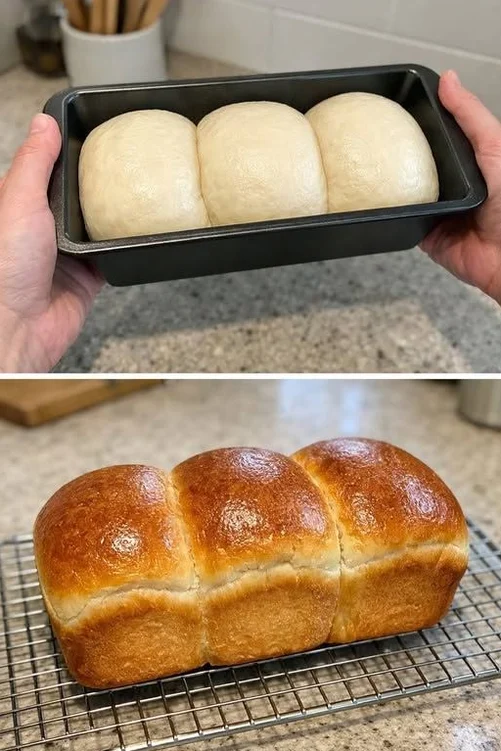
- Shape and Second Rise: Punch down the dough and turn onto a floured surface. Divide into three equal pieces. Shape each into a ball, cover, and rest for 10-15 minutes. Roll each piece into an 8-inch oval. Fold the top third to the center and the bottom third to the center. Turn 90 degrees and roll out into a long rectangle. Roll tightly from top to bottom to form a log, pinching the seam to seal. Place the three logs seam-side down in a greased 9×5-inch loaf pan. Cover loosely and rise for 45 minutes to 1 hour until just above the rim.
- Bake: Preheat oven to 350°F (175°C) about 15 minutes before the second rise is complete. Whisk egg yolk and milk for the egg wash and brush over the top of the dough. Bake for 30-35 minutes. Tent with foil if the top darkens too quickly. The bread is done when deep golden brown, the internal temperature is 190°F (88°C), and it sounds hollow when tapped.
- Cool: Immediately turn the loaf out of the pan onto a wire rack. Let cool completely before slicing to prevent a gummy texture.
Advertisement
Notes
Storage: Store in an airtight container at room temperature for 3-4 days. Freezing: Slice, wrap tightly in plastic, and freeze for up to 3 months; toast directly from frozen. Serving: Good for toast, French toast, bread pudding, or sandwiches like egg salad or katsu sando. Nutrition (per slice, assuming 12 slices): ~210 kcal, 6g Total Fat, 3.5g Saturated Fat, 45mg Cholesterol, 200mg Sodium, 33g Total Carbohydrates, 1g Dietary Fiber, 6g Sugars, 7g Protein.
Advertisement